

Siemens Energy Is Spinning Out Its Industrial Unit — and the Electrolyser Business Goes With It
One of Europe’s most significant electrolyser manufacturers is about to become its own company. Siemens Energy announced on August 25 that it is beginning legal and operational preparations to separate its Transformation of Industry business area, with the goal of establishing it as a fully independent industrial energy solutions company. The new entity will initially operate under the Siemens Energy brand before transitioning to a new name: Omterra.
What is being spun out
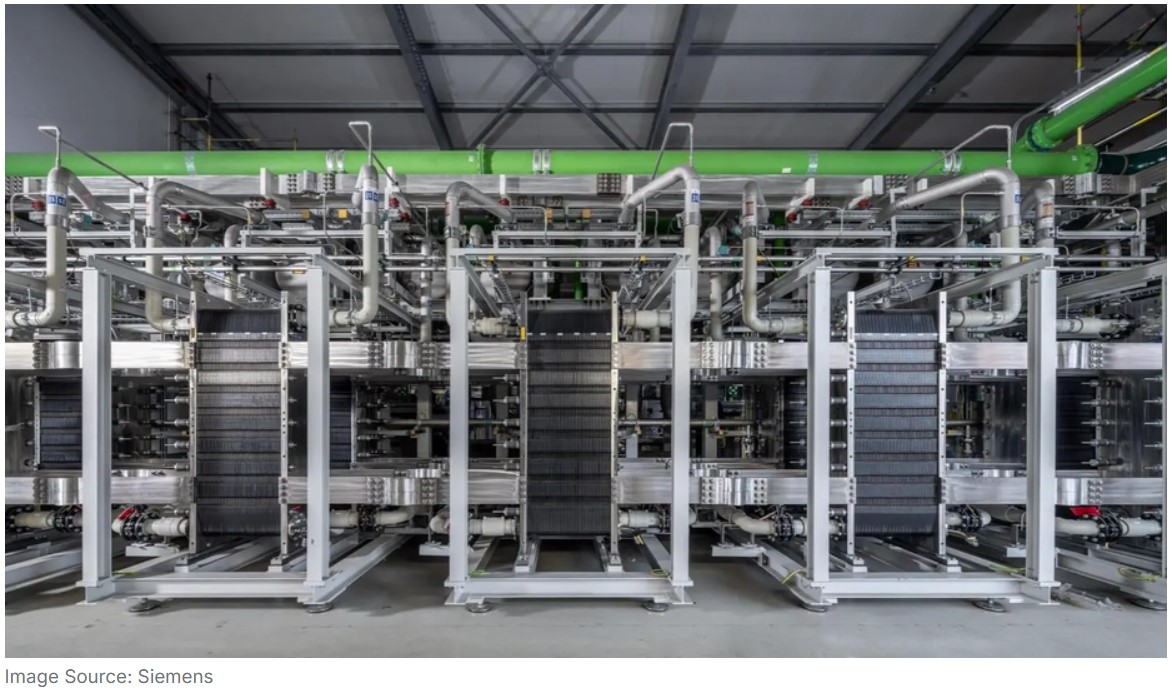
Transformation of Industry is not a minor division. In fiscal year 2025, its approximately 17,000 employees generated €5.7 billion [$6.27 billion] in revenue at an 11.3% profit margin — making it a sizeable, profitable industrial business in its own right. The portfolio spans industrial steam turbines, compressors, electrolysers for hydrogen production, generators and motors, as well as maritime and subsea technologies.For the hydrogen industry, the critical element is the electrolyser business. Siemens Energy’s PEM electrolyser operation, centred on its gigawatt-scale automated manufacturing facility in Berlin, has been one of the largest European electrolyser production platforms. With more than 350,000 electrolyser operating hours of experience, 330MW in operation as of 2026 and 1GW in execution, it has supplied major projects including Air Liquide’s 200MW Normand’Hy plant in France and EWE’s planned 280MW facility in Emden, Germany. That business now exits Siemens Energy’s direct ownership structure.
Why Siemens Energy is doing this
The structural argument is equally clear. Within Siemens Energy, Transformation of Industry competes for capital allocation against the grid and power generation businesses — which are currently growing even faster and attracting the bulk of investment attention, driven by the global energy infrastructure buildout. Bruch put it plainly: “If we don’t change our structure, we limit what Transformation of Industry can achieve. Our current investment focus is on power generation and power transmission, with higher immediate payback.”
As a standalone entity, Omterra would have its own investment case, its own capital structure and the ability to bring in external investors or pursue a capital markets transaction — without being subordinated to the faster-growing grid business in the annual capital allocation process.
What Siemens Energy keeps
After the separation, Siemens Energy will focus on power generation (gas turbines, steam turbines for power, offshore wind through Siemens Gamesa) and power transmission (transformers, switchgear, HVDC, grid automation). It intends to retain a meaningful minority stake in Omterra to support its continued development, but the business will be fully deconsolidated — off Siemens Energy’s balance sheet.
The German manufacturing footprint
The business being carved out has a substantial German industrial presence: Duisburg (approximately 1,500 employees), Erlangen (approximately 700), Görlitz (approximately 650), Muelheim an der Ruhr (approximately 550), Nuremberg (approximately 550), Erfurt (approximately 550), Hamburg (approximately 250), Leipzig (approximately 200) and Berlin (approximately 150). Manufacturing sites also operate across Europe, the United States, India, China, Brazil and Saudi Arabia.
With a service share of approximately 50% of total revenue and more than 85,000 units installed globally, the future Omterra company has a stable recurring revenue base — and an electrolyser business that, once freed from internal capital competition, may finally get the investment acceleration it has been waiting for.
More information:https://fuelcellsworks.com/2026/08/26/electrolyzer/siemens-energy-is-spinning-out-its-industrial-unit-and-the-electrolyser-business-goes-with-it
