

ESCA Launches BESS Procurement Contract With 22 Members
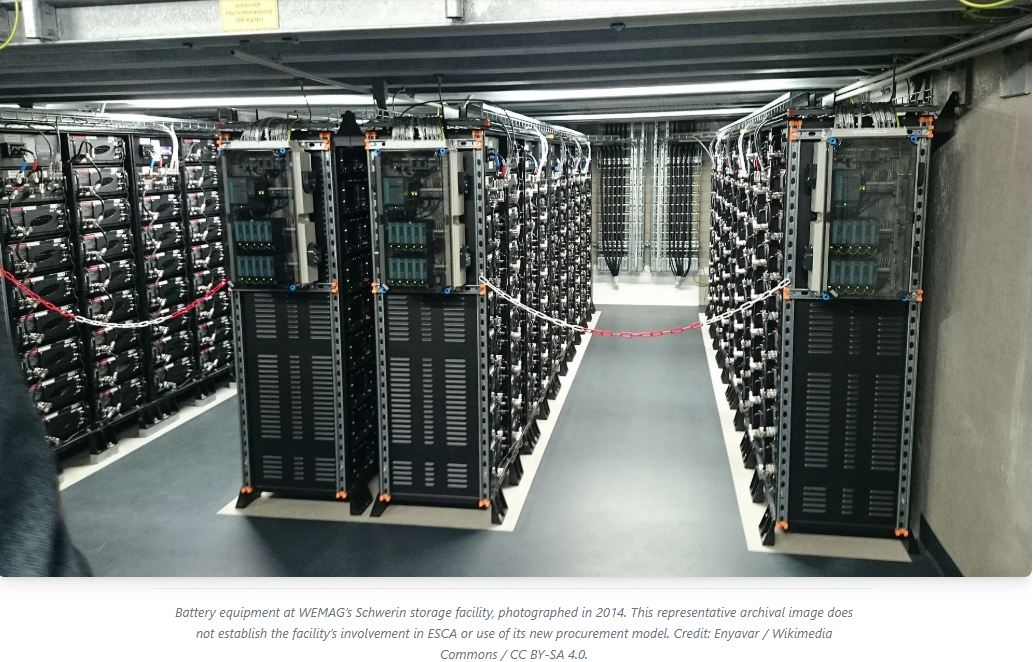
The Energy Storage Contract Alliance has launched a publicly readable BESS procurement contract intended to give utility-scale battery buyers a common starting point for equipment purchases. In its October 13 launch announcement, ESCA said its 22 members represent 40 GWh of battery projects worldwide.
The Swiss nonprofit’s model addresses equipment specifications, acceptance testing, commissioning, warranties, payment arrangements and cybersecurity. Its potential value lies in making technical obligations and risk allocation easier to compare before a battery project reaches construction or financing. ESCA has not published evidence that the new framework has already reduced costs or accelerated project delivery.
What the BESS procurement contract covers
The published version 1.2 agreement contains sections covering factory inspection, delivery, site acceptance, monitoring, warranties, software and data, subcontracting, liability and dispute resolution. ESCA says its supporting technical appendices address requirements at system, rack, pack and cell levels.
Those topics extend beyond a battery’s headline megawatt and megawatt-hour ratings. A procurement agreement also determines which measurements demonstrate acceptable performance, what happens when delivery slips, who must remedy defects and what information the owner can obtain during operation.
The document is drafted from the buyer’s perspective. Sinovoltaics, ESCA’s technical secretariat, prepared the initial baseline, while members can comment and the steering committee decides revisions. ESCA identifies MN8 Energy, Neoen, Fortum and Munich Re among steering-committee participants.
Energy-Storage.news independently reported the launch and the participation of developers including BW ESS. The alliance’s reported 40 GWh describes its members’ project experience or portfolios, not a new order or 40 GWh of batteries commissioned by ESCA.
Testing and data obligations can shape project acceptance
The model links procurement to factory and site acceptance processes rather than treating delivery alone as proof of a functioning asset. Its scope includes inspection records, commissioning responsibilities and monitoring provisions alongside the equipment supply.
That connection matters because a battery installation includes cells, power conversion, controls, thermal management and other equipment that must work together. Microgrid Media’s commissioning guide explains why individual equipment tests do not establish that an integrated energy system will perform as required.
The ESCA model is aimed at utility-scale BESS procurement. It should not be assumed to provide a complete commissioning plan for every islandable microgrid, whose protection, transitions and critical-load requirements introduce additional system-level questions.
Actual supply agreements remain specific to the buyer, supplier and project. Microgrid Media’s reporting on the Saft–Axpo battery contracts illustrates how procurement identifies equipment and delivery schedules while commercial operation still depends on later construction and commissioning milestones.
A voluntary reference, with access limits
ESCA says anyone can read its core clauses without charge, while registered membership provides access to the full technical appendices and participation in the standards process. Public readability should not be confused with an unrestricted open-source license; the model identifies itself as proprietary to ESCA.
Use is voluntary. Buyers and suppliers can adopt, amend or disregard the baseline. The alliance says it sets no prices, price levels or discounts and does not participate in members’ commercial negotiations.
The launch therefore establishes a reference framework, not a mandatory regulation or proof that lenders and suppliers will accept every proposed clause. ESCA’s stated goal is to reduce repeated drafting and uneven treatment of common technical issues; those outcomes remain to be demonstrated through adoption.
Adoption will determine the practical impact
The next useful evidence will be whether procurement teams use the model in tenders, which provisions survive negotiations and how future revisions respond to operating experience. The launch materials do not identify completed transactions executed under the new framework.
The BESS procurement contract offers a more visible baseline for comparing equipment obligations and project risks. Its significance will depend on how consistently those obligations translate into signed agreements, tested systems and enforceable operating commitments.
More information:https://microgridmedia.com/esca-bess-procurement-contract-launch/
