
Nuclear needs to build up to 8,000 SMRs just to catch up with wind and solar. By 2035, they might have 5
Australia’s almost indistinguishable far right political parties – the Liberals, Nationals and One Nation – are pushing the nuclear barrow once again, not for climate reasons but because of the “anything but wind and solar” ideology demanded by their fossil-fuelled benefactors.
So it came as a timely reminder on Wednesday, when one of the world’s leading green energy analysts, Michael Liebreich, underlined just how useless nuclear energy is for dealing with climate change, and how far the small nuclear reactors championed by many are from competing with surging wind and solar.
Liebreich is the founder of Bloomberg New Energy Finance and his address to the Energy Efficiency Council’s National Conference also touched on the perils of net zero targets (because it puts the focus on what’s really hard rather than what’s readily achievable), and the overwhelming push for electrification for “just about everything.”
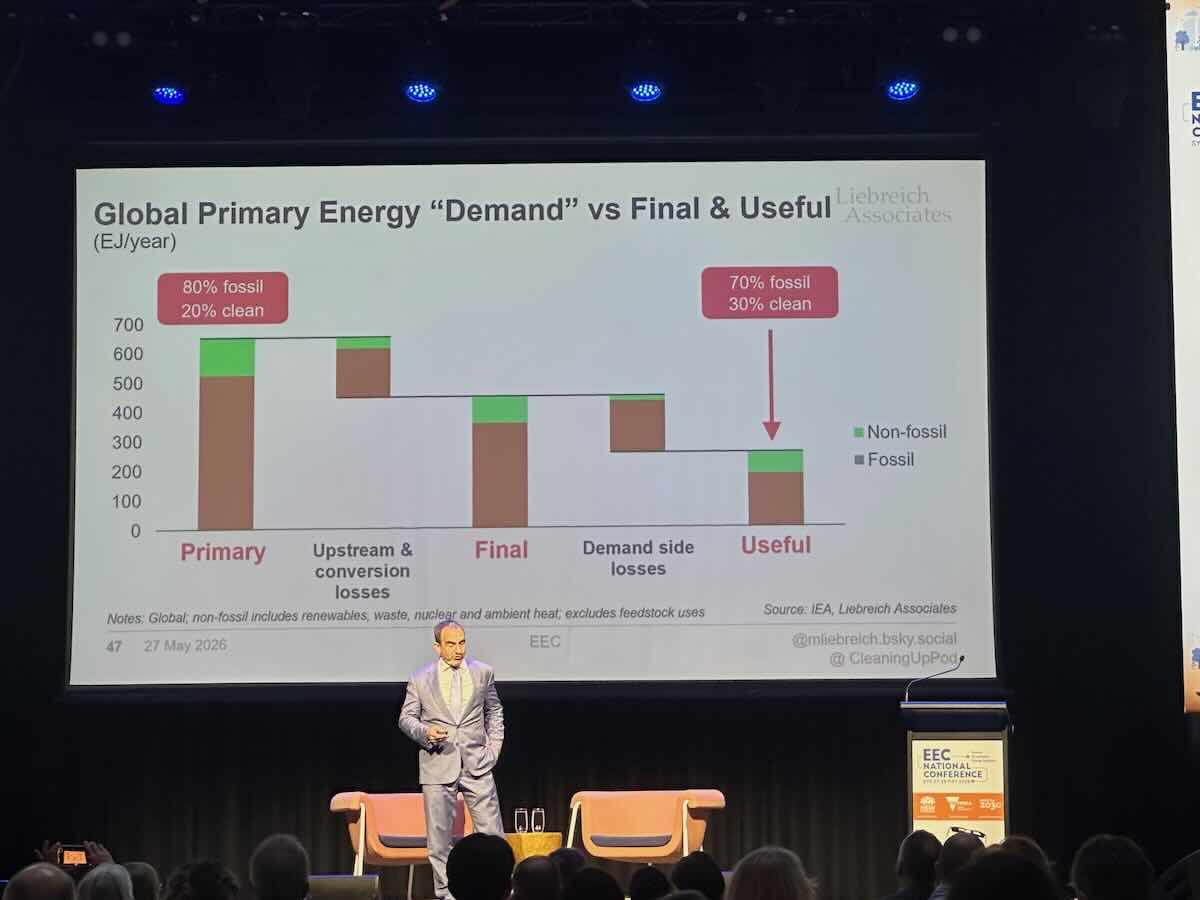
But it was the nuclear hype that he was also keen to puncture, if only to underline the sheer scale and dominance of wind and solar, and its rapidly growing share of “useable” energy, as opposed to “primary energy” that ignores the massive inefficiencies of fossil fuels.
SMR are still not being built but they are championed by some of the world’s richest people, the AI and social media “tech bros” who are looking for ample energy sources to power their massive data centre needs (while contracting tens of gigawatts of wind and solar in the meantime).
“They (the tech bros) love nuclear, and they’re going to be very angry when they discover what everybody discovers, which is nuclear is kind of expensive and long and complicated,” Liebreich said.
“But even if they succeed, it’s not going to be a climate solution,” he said. And the reason is that simply to match the output of wind and solar in the 2024 calendar year, the industry would need 1,250 of the 470 MW SMRs that are being developed by Rolls Royce, or up to 8,000 of the much smaller SMRs pushed by the likes of Oklo.
“If they build five by 2035 that will be a big win,” Liebreich said. “And so, as a climate solution, by the time you did build 2000 Westinghouse SMRs, where do you think wind and solar is going to be?
“It’s obviously going to have grown. That green curve is not stopping, it is taking off, and you can see it’s taking off even in the countries that are really trying to build nuclear.”
The nuclear push is usually associated in Australia by calls to abandon net zero targets, with the main argument being – without evidence – that it is trashing the economy.
Net zero has been criticised by others supportive of strong action. Andrew Forrest, aiming for real zero at Fortescue’s giant iron ore mines by 2030, says net zero is an excuse to do not much and use offsets instead of cutting emissions, others say a 2050 target is used by an excuse to do not much anytime soon.
Liebreich’s criticism is that it makes everything sound too hard. “By focusing on zero, immediately your eye is drawn to doing the difficult bits, and the difficult bits are expensive, and we just don’t have to have those discussions right now.
“If we can’t do aviation, there’s … a smorgasbord of opportunities right in front of us that we should be doing first and quickly, because time matters. Carbon has a time value, once it’s up there, it stays up there.”
As an example of that smorgasbord, Liebreich pointed to EVs, and specifically the Nissan Leaf, which from its 2011 version to its 2026 version had trebled the size of its battery, quadrupled its range, doubled the power, and cut the cost by one third.
Simply looking at efficient technologies can also achieve so much.
“If you go from coal-fired incandescent light bulb to an LED, same energy service, you cut primary energy by 95 per cent.
“Electric cars are the same, you go from a fossil car to electric car, (you get a) 75 per cent cut in primary energy. Same for heating, you go from a boiler to a heat pump, (you get) a 75 per cent reduction in primary energy.”
Liebreich says the greater efficiency of wind ands solar – useable energy as opposed to the primary energy championed by the fossil fuel industry trying to pretend that non-hydro renewables have no impact – will accelerate that change.
“What it does is it pushes fossil off the system, it’s a transition, and if you think about it, when we went from analog to mobile and digital telephony, we didn’t measure it by how many landlines were disconnected in 1995.
“We just asked how many people have got mobile phones. Peak landline happened over 30 years after the invention of the mobile phone, in 2006. So if you had said in 2000 there’s no transition, it’s failed, it’s troubled, it’ll never happen, you look pretty stupid now.
“Peak horse in the US was 1920. The car was invented in 1886. So you measure a transition by the growth of the new, not the crushing of the old.
“And I also think … the politics of talking about how we’ve got to stop this and block this and destroy that, and so it’s very, very difficult.
“We’re telling people you’re going to stop them from using things, whether it’s coal or petrol or diesel or their boiler, or whatever, it is politically difficult. Well, it’s unacceptable. So I think we’ve got to talk about growing anew. That brings me to electrification, and electrification, I think, is the solution to all of the above.”
More information:https://reneweconomy.com.au/nuclear-needs-to-build-up-to-8000-smrs-just-to-catch-up-with-wind-and-solar-now-by-2035-they-might-have-5/
