

Grid reforms vital to powering South-east Asia’s green growth: Report
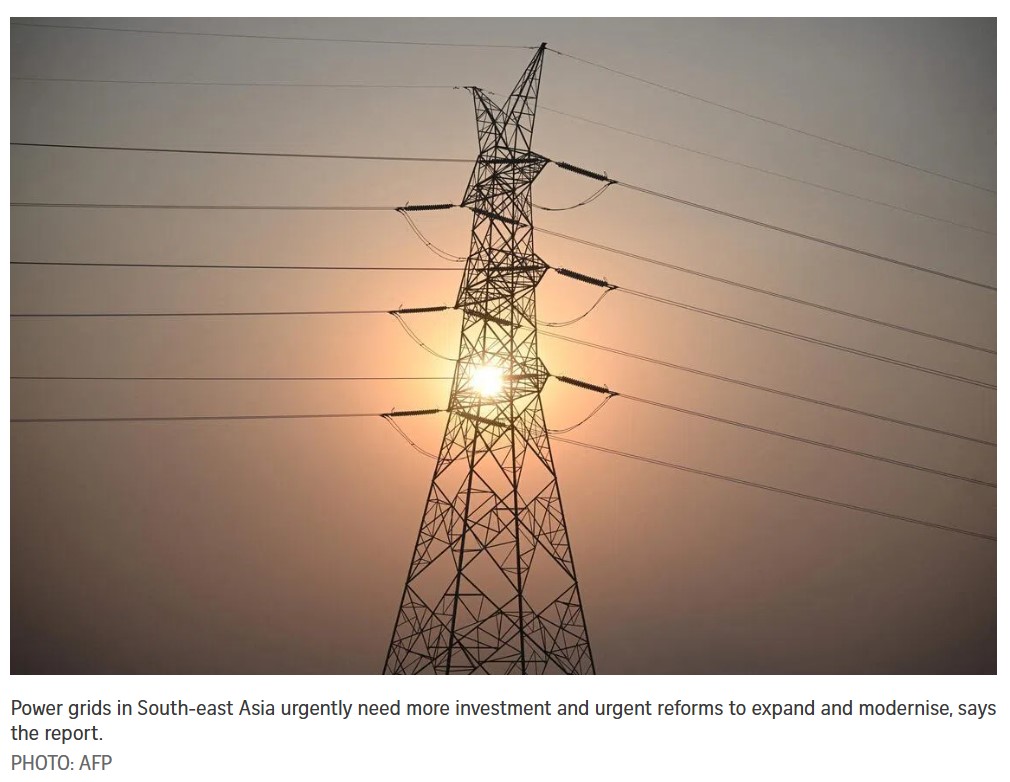
SINGAPORE – South-east Asia risks missing out on billions of dollars of green investment because its underfunded power grids are failing to keep pace with surging energy demand, a report released on May 18 warns.
The report by Bain & Company and Standard Chartered bank says the region is facing a crunch point. Investors are lining up to invest in data centres, renewable energy, green industrial parks, and electric vehicle (EV) production and infrastructure. But most power grids in South-east Asia have limited regional interconnections and are not adapting fast enough to meet the rapid electrification of economies.
Some investors are deterred by long grid connection times, lack of policy clarity, and rigid rules of bureaucratic state-run power companies in the region, home to nearly 700 million people and one of the world’s fastest-growing energy markets.
The region’s grids urgently need more investment and reforms to expand and modernise, says the report. Many are governed by a hotchpotch of inflexible rules limiting private operators and a lack of innovative power purchase agreements. Long grid connection times also frustrate investors, such as data centre developers who cannot afford to wait several years.
The constraints are already affecting clean energy projects. For example, between 50 per cent and 60 per cent of renewable energy projects in Vietnam, Thailand and Indonesia have been cancelled between 2021 and 2025 because of system constraints, including unclear power-purchase agreement structures, permitting hurdles and grid connection rules, the authors note.
Grid investment has failed to keep pace with demand growth. Annual investment in power transmission and distribution fell 3 per cent between 2015 and 2025 in South-east Asia, even as investment grew by 10 per cent annually in the European Union and 8 per cent in the United States.
South-east Asia should be spending US$29 billion (S$37 billion) a year on grid infrastructure but is investing only US$11 billion. This leaves an US$18 billion annual investment gap, putting the region’s growing green economy at risk.
The green economy is growing at 8 per cent to 9 per cent annually and is worth US$290 billion. By 2030, it could reach US$430 billion, the authors say. But there is a significant gap between investments announced and what is likely to be built.
“Of approximately US$540 billion in green capital expenditure announced across South-east Asia’s power and EV value chains between now and 2030, only around US$315 billion is on a credible path to deployment under current conditions.
“Capital is flowing where commercial demand, energy security and policy that delivers infrastructure come together, and stalling where any of the three is missing,” said co-author Dale Hardcastle, partner at Bain & Company, in a statement.
New electricity demand from data centres, rapid adoption of EVs, and green industrial clusters could be a major catalyst for the region’s green transformation, the authors say. But this requires grid reforms and greater investment in renewable energy and battery storage.
Over the next three to four years, the region is projected to face more than 100 terawatt-hours of new energy demand from data centres, EVs and green industrial parks, representing more than US$200 billion in committed investment, the authors say.
A key problem, however, lies in the infrastructure timelines. Data centres, EV infrastructure, and production and green industrial parks can all be built in one to three years. Yet, the grid required to serve them takes at least five years to build, creating a structural time-to-power gap.
The report referenced a Bain survey of regional data centre operators and large global data centre developers, which found that 90 per cent cited grid connection delays as a top constraint, while 70 per cent cited grid transmission capacity limits.
Solutions include the quick deployment of solar and battery storage to meet near-term power demand, fast-tracking grid interconnections for high loads for key investments, and enabling private participation in power transmission and distribution. In the longer term, solutions include establishing regional power markets and strengthening interconnections under the ASEAN Power Grid initiative.
Unlocking these system constraints could mean an additional US$70 billion in clean energy investments.
More information:https://www.straitstimes.com/asia/se-asia/grid-reforms-vital-to-powering-aseans-green-growth-report
